
Elon's Misunderstood "Machine"
SpaceX, Tesla, etc.

This will be a little different than my normal posts. Why is that? Well, because in my longer-term portfolio, I do own SPCX & TSLA as well. Both tucked away. Not my typical bottleneck/supply chain play. I hope after reading this, you understand my why behind my investments. Also, before you think that me posting this is somehow bearish on terrestrial data centers, it is not. There is still a need for them. I am still in my core holdings, my bottleneck plays, still holding strong in all of them, because the thesis is real. My whole idea around writing this is to inform everyone of some of the things I have been reading throughout my many nights of deep research, early mornings, and even sleeplessness. I think both companies are interesting and there is a lot of FUD surrounding both. Let’s dive in.
Quick disclaimer: I am not a financial advisor so nothing from this article should ever be considered financial advice. Yes, I do own stakes in multiple companies I will talk about in the article. As always, DYOR/DD, and best of luck to you. If anything below is wrong, outdated, anything at all, please let me know. I dig through tons of news, articles, sitting in VS Code building graphs, so please, let me know gracefully.
I. The Machine
He is running one machine, and charging five separate prices for it. A big misconception about Elon is that he is running five completely different companies. How do they even connect? Space, FSD, robots? What?! I understand the confusion, but let me explain it to you.
The market files these businesses as separate stories with separate analyst desks — Tesla is a car company, SpaceX is a rocket company, Starlink is an internet company, xAI is an AI lab, Optimus is a science project that is not happening. Five mental boxes, five valuations, five different sets of people arguing about five different things. And the moment you finally follow what flows through those boxes, well, the walls come down and you realize you are looking at one system, carefully designed, wearing five costumes.
The same inference chip Tesla designs to go into the car, the humanoid robot, and the data center. The same neural networks, trained on the same fleet of real-world driving miles, teach the car to drive and the robot to move. The same batteries Tesla builds to store solar energy also buffer the power grid that feeds the supercomputer. And the same rockets that loft satellites are, per the company’s own filing, about to carry the data centers themselves into orbit. It is a single vertically integrated system in which the output of each layer is the raw input to the next.
Lay the flows E2E and they close into a loop. Tesla’s energy business powers the compute. The compute trains the AI. The AI runs on Tesla’s own silicon. The silicon drives the cars and the robots. The cars and robots generate real-world data that no one else has. That data sharpens the AI, which spins the whole thing faster — and SpaceX sits underneath all of it, launching the hardware and carrying the connectivity that ties the system together on Earth, and soon above it.
Every other AI company on the planet rents layers of the stack. They buy chips from NVDA, compute from a cloud, connectivity from a carrier, data from whoever will sell it. Elon owns all of it. That is the thesis right there.
II. The Filing
On June 12, SpaceX went public. It priced 555,555,555 shares at $135 and raised roughly $75B — the largest IPO in history, past Saudi Aramco — opened higher, and closed its first day at $160.95, up 19%, at a market cap near $2.1T. Elon came out the other side still holding about 82% of the voting power, which matters more than it looks, because it means NONE of this is up for a vote.
Everyone saw the headline number. Almost nobody opened the prospectus, but I did! The prospectus is where the story lives, because a company can tweet whatever it likes but it cannot lie to the SEC, and the things SpaceX chose to tell its investors under that constraint are things worth your attention, shareholder or not.
The first is that the financials quietly describe the machine I am talking about. SpaceX did $18.7B in revenue in 2025, up 43% in a single year. Starlink alone did $11.4B of that and threw off $4.4B in segment operating income — ~39% margin. The launch business added $4.1B. And then there is a brand new $3.2B AI segment — xAI now lives inside SpaceX. The prospectus discloses, in its own words, “the xAI merger… effective February 2, 2026,” with each xAI preferred share converted at 0.1433 of a SpaceX share — a roughly $1.25T combination, the biggest merger ever recorded (private), and the move that quietly made SpaceX rather than Tesla the balance sheet anchor of the entire AI empire.
The second thing, and the one that made me put everything else down, is what SpaceX tells its investors it is building. Not in a keynote, not in a tweet, but in a business section of a federal offering document: “satellite constellations that act as orbital data centers, harnessing solar energy for power… We expect to begin deploying our orbital AI compute satellites as early as 2028.” And in the compensation section, Elon’s stock does not fully vest on revenue or profit. It vests on “a permanent human colony on Mars with at least one million inhabitants” and “non-Earth-based data centers capable of delivering 100 terawatts of compute per year.”
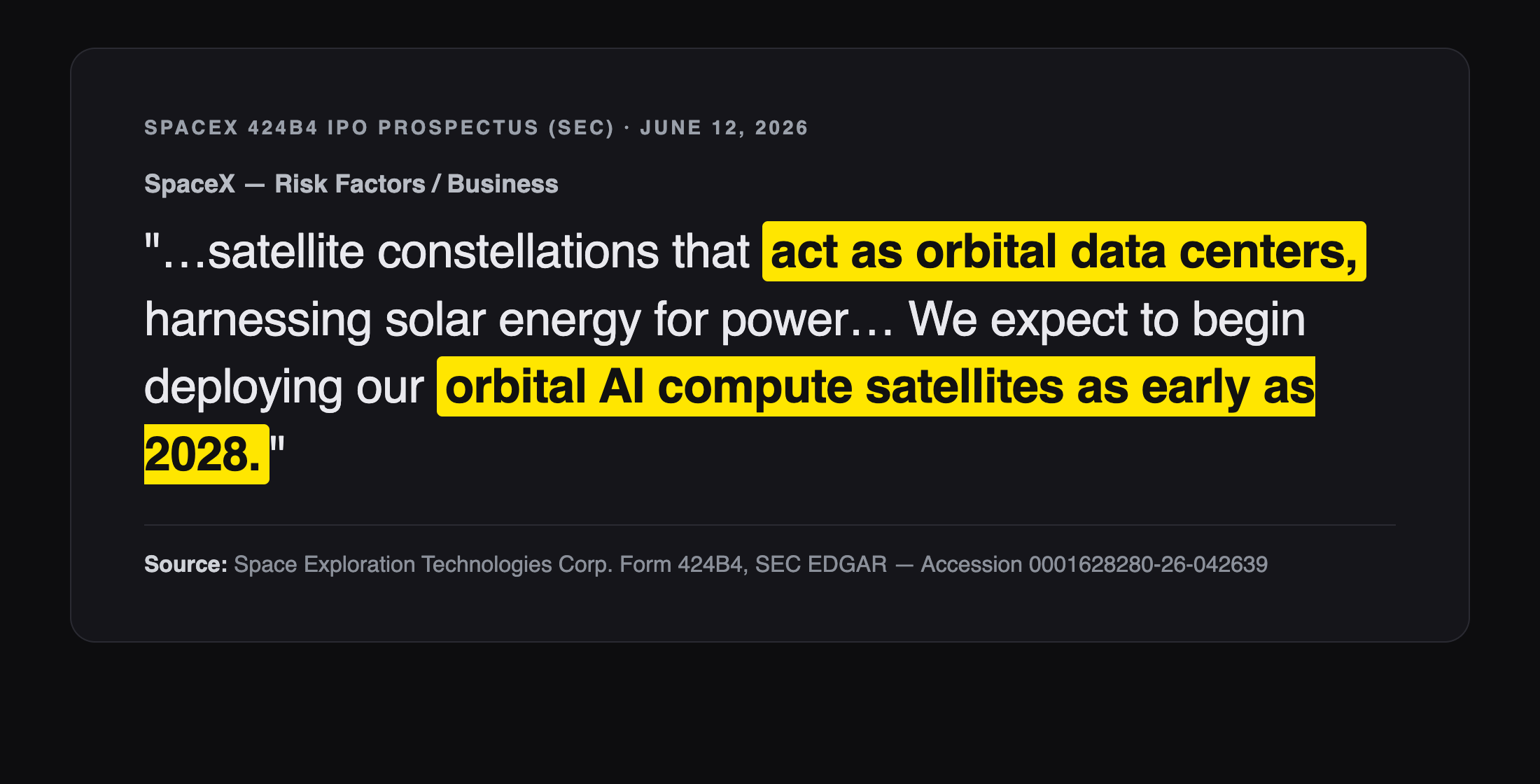
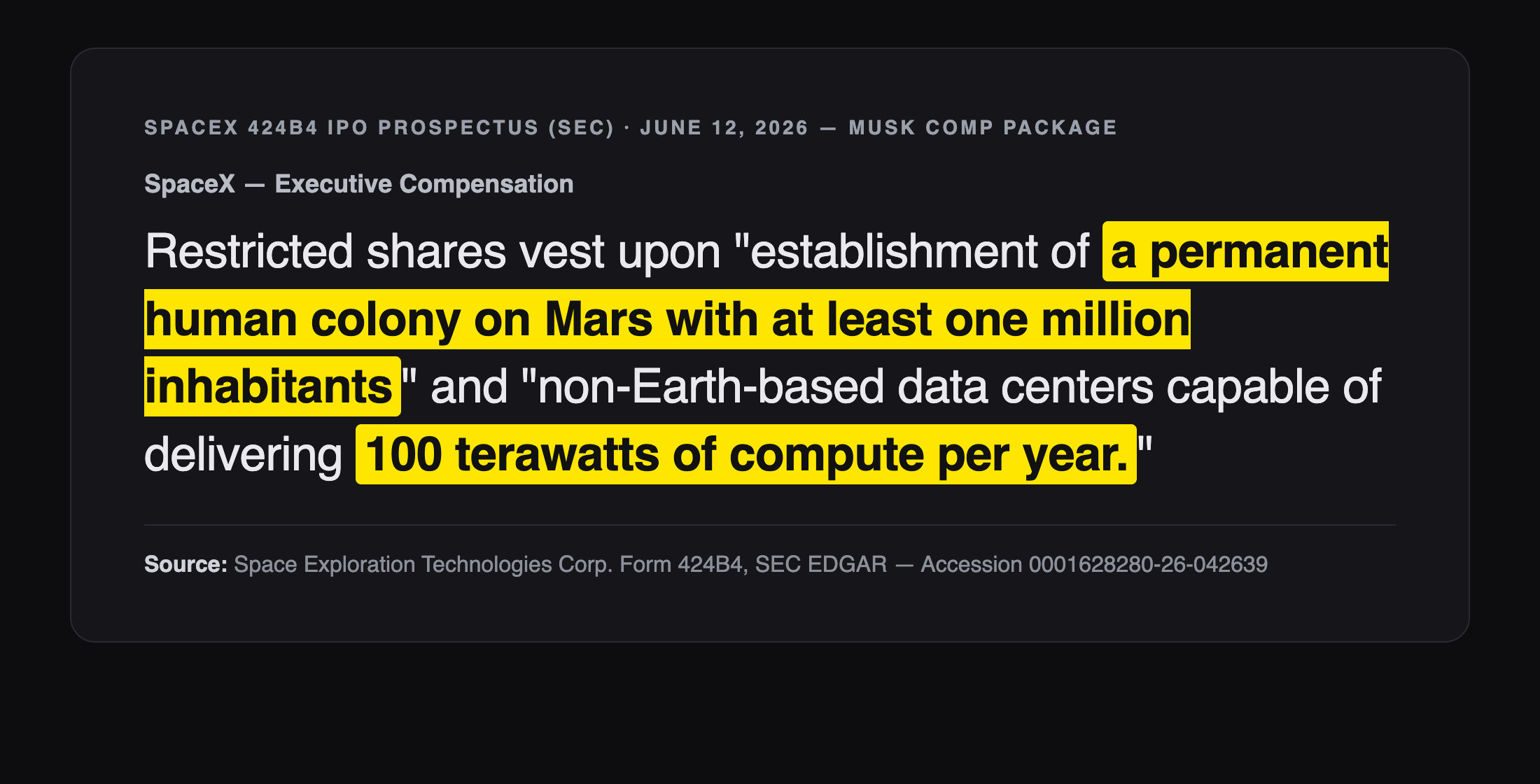
This is the official offering document of the most valuable private company ever created, telling Wall Street that the plan is data centers in orbit by 2028 and a million people on Mars, with the founder’s fortune wired to both. The market read all of it and bought “a rocket stock.” Haha, there is a gap there, you agree? That gap is my edge.
III. The Chip
If you’ve read my other work, you know I always end up at the same question: what is the scarce link? In AI, the answer is not subtle. The planet is fighting over cleanroom space and the same HBM (right now).
Elon decided to attack compute directly. The path starts with a chip Tesla already designed. On the Q3’25 earnings call, he described the new AI5 inference chip as “40 times better than the AI4 chip. Not 40%, 40 times,” and then said that the explicit goal is to build an oversupply of the chip, so that “if we have too many AI5 chips for the cars and robots, we can always put them in the data center.”
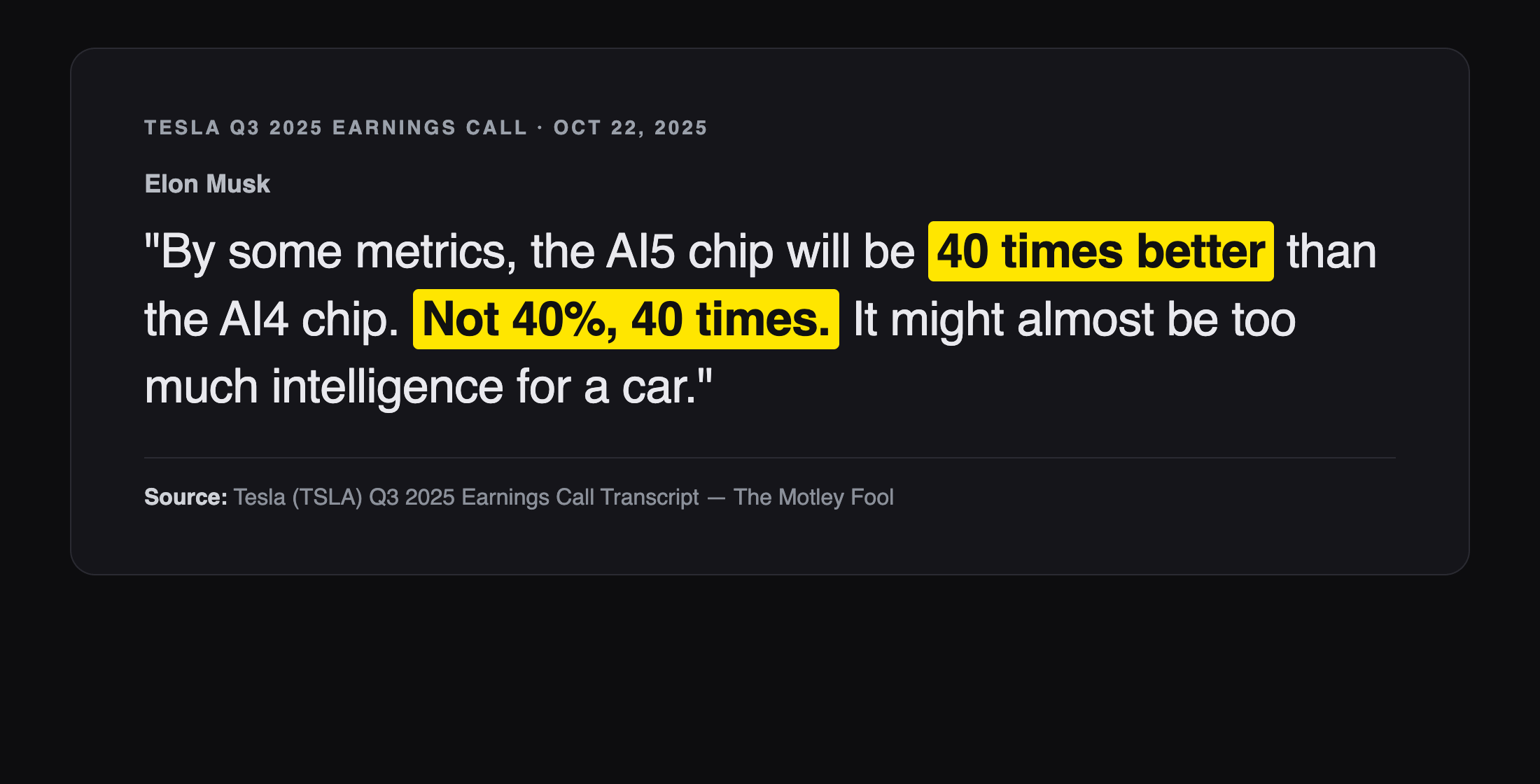
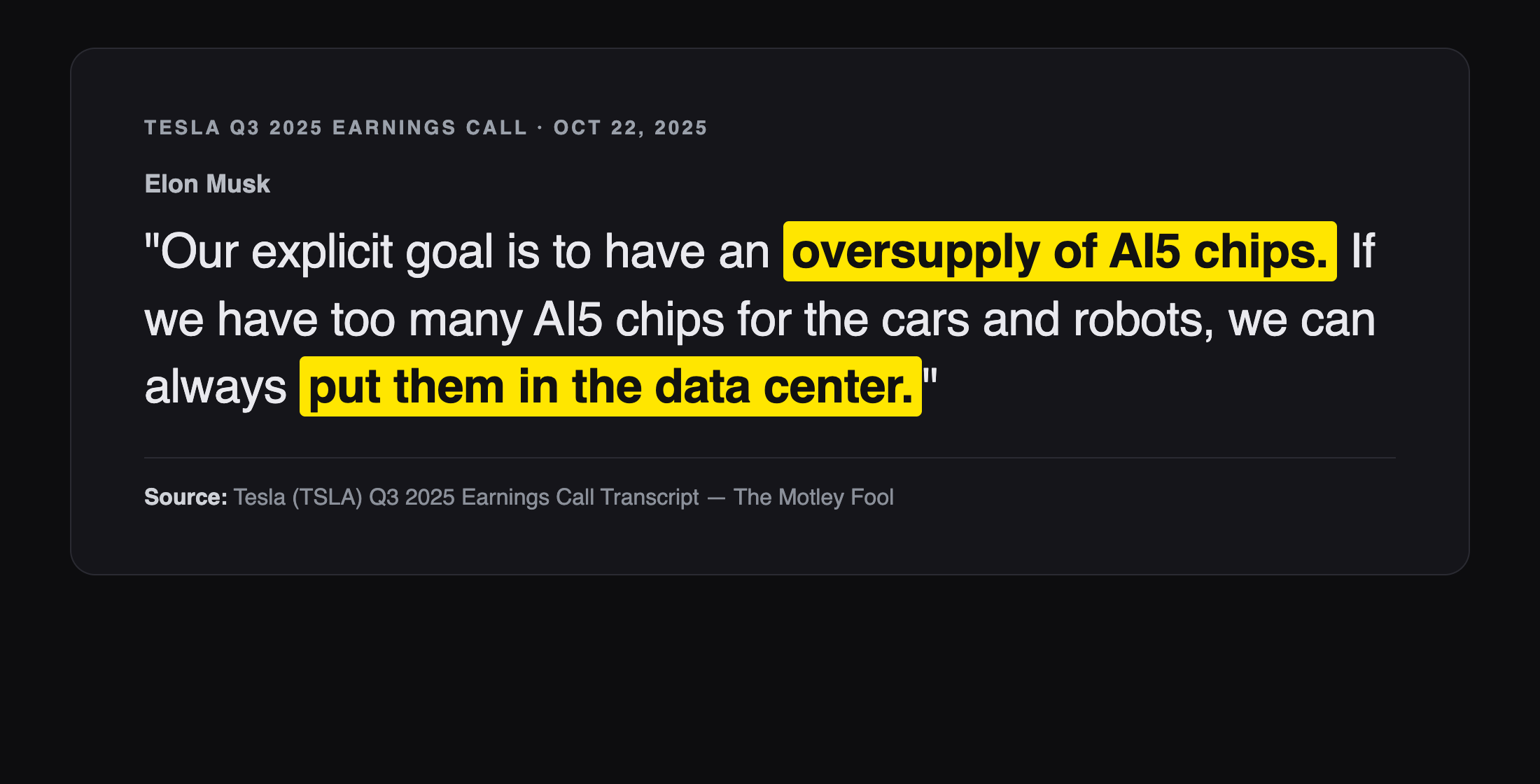
One piece of silicon, designed once, feeding the car, the robot, and the cluster. AI6 pushes the same idea further, a single design fabbed at both TSMC Arizona and Samsung’s plant in Taylor, Texas. He even killed the Dojo supercomputer in August 2025, calling it “an evolutionary dead end,” precisely because every path had converged onto that one unified chip.
But designing a chip and building one are different problems, and the build is the bottleneck here. So in March 2026, on a stage at a decommissioned power plant in Austin, Elon announced he was going after that layer too. Terafab — a joint Tesla, SpaceX, and xAI (& Intel) venture to fab chips at a scale with no precedent, starting at 100k wafer starts/mo and aiming for over a million. The initial cost on the Grimes County, Texas tax filing is $55B for the first phase, scaling to as much as $119B fully built, anchored on Intel’s 14A process — which makes Tesla the first major external customer. His own framing was that it would be “the most epic chip-building exercise in history,” an attempt to “turn science fiction to science fact.”
The hard physical wall is EUV lithography, Terafab would need hundreds of these machines.
IV. The Cellular Takeover
Over three deals beginning in September 2025, SpaceX bought EchoStar’s licenses: roughly $17B for the AWS-4 and H-block bands, another $2.6B for nationwide AWS-3 uplink spectrum, and about $2B more funding EchoStar’s debt along the way. Stack those together and SpaceX now controls roughly 65MHz of contiguous, nationwide, mid-band licensed spectrum (40MHz of AWS-4, 15MHz of AWS-3, and 10MHz of H-block).
To see why that is a big deal, look at how Starlink connects phones today. The T-Satellite services has been live commercially since July 23, 2025, costs $10 a month, and already kills dead zones for texting with voice and data rolling out — but it does so by borrowing T-Mobile’s spectrum. A company that owns its own nationwide spectrum does not have to borrow anyone’s. It can sign you up and bill you directly. And at the June 2026 IPO roadshow, SpaceX President Gwynne Shotwell told investors that the company is, in the Financial Times’ words, “actively considering a Starlink-branded retail mobile service” in the US, under its own brand.
However, I want to be careful here, because this is the place the thesis is easiest to oversell. That roadshow line is stated intent, not a shipped product (yet). Every binding agreement SpaceX has today in still wholesale, it owns no terrestrial towers yet. But, there are roughly 10,400 Starlink satellites in orbit, about 75% of every active satellite circling the planet, 10.3 million subscribers, FCF positive since 2024, and now its own nationwide spectrum plus a public statement of intent to go to retail. The components of a global mobile carrier — one that works in the middle of the ocean and especially Sand Hill Rd — are already in space. The market is still calling it satellite internet.
V. The Robot
Now, if you’ve followed Tesla at all, you’ve seen the image: Optimus robots stationed at every supercharger, plugging in and washing down the robotaxis as they roll through. Great image, I agree, but not a real Tesla plan.
I went looking for the quote where Elon says Optimus will service the robotaxi fleet, and could not find it. At the robotaxi reveal he was explicit that the Cybercab has no plug at all — it charges inductively, wirelessly — and the cleaning was shown as an automated wash bay, not a robot with a rag. Someone will quote the “no plug” line back at you the moment you post about it. The real version is more interesting than the memes anyway, and it splits in two. One half being what Tesla is doing with the physical robot at its sites: starting where it can fail safely, like the Tesla Diner, where Optimus served popcorn in 2025 and is being promoted to running food out to cars. Low stakes, real footage, yet no robotaxi in sight.
The other half is the one he can’t stop talking about, and I understand why. It has NOTHING to do with a robot holding a rag as I previously mentioned. Rather, it’s the idea that the cars and the chargers themselves quietly become a data center.
Don’t believe me? Here is what he said on the Q3’25 call: “might almost be too much intelligence for a car [AI5 chip],” and then he made the leap to “If we’ve got all of these cars that maybe are bored… we could actually have a giant distributed inference fleet.” What. The. F.
Then he did the math out loud: “If you’ve got 100 million cars in the fleet… and let’s say they had, at the point, a kilowatt of inference capability… that’s 100 gigawatts of inference distributed with cooling and power conversion taken care of.”
100GW. The largest AI data centers anyone is seriously planning today are measured in low single-digit GW and cost billions to build — bottlenecked by power, cooling, and a grid connection big enough to feed them. Elon is pointing at a fleet of machines that already solved all three. Every Tesla is a liquid-cooled, power-converted, grid-connected computer that happens to sit parked ~23hrs of the day. On that framing the data center doesn’t need to be built. It’s essentially already built, and might even be sitting in your driveway — if you own one — or in the parking lot at your office if that is where you are reading this.
Then in March 2026 he gave the idea a name, and a confusing one at that: “Digital Optimus.” It is not a physical robot, but a distributed brain. Tesla and xAI pooling the idle compute inside the parked cars and at the charging sites into a single network. His own words on X: “it works in all AI4-equipped cars, so your car can do office work for you when not driving. We’re also deploying millions of dedicated Digital Optimus units in the field at Superchargers where we have ~7 gigawatts of available power.”
The charging station piece is not a robot washing a car, no, it’s racks of compute bolted to the one asset nobody else has. Tesla has even filed a trademark,”MEGAPOD,” for exactly this: modular data center hardware — servers, networking, power distribution, liquid cooling — built to drop straight into Supercharger sites. Stand up 7 gigawatts of data center from scratch and you’re looking at an estimated $70-140B and 5-10 years of permitting and grid fights. Tesla’s charging network already has the power, the land, the grid interconnects, already spans the globe. It was sitting there the entire time, filed on the books as a cost of selling cars.
Now, line that up against the chip section. Tesla builds a deliberate oversupply of AI5 and the extras don’t sit in a warehouse. They go into the cars as latent inference, into MEGAPODs at the chargers, into dedicated racks.
Most of this is announced, not shipped. Digital Optimus is targeted at roughly September 2026. The 100GW figure assumes 100 million cars Tesla hasn’t sold and owners who agree to rent out their car’s brain, with real questions about battery wear, bandwidth, and privacy. I model it more as option value.
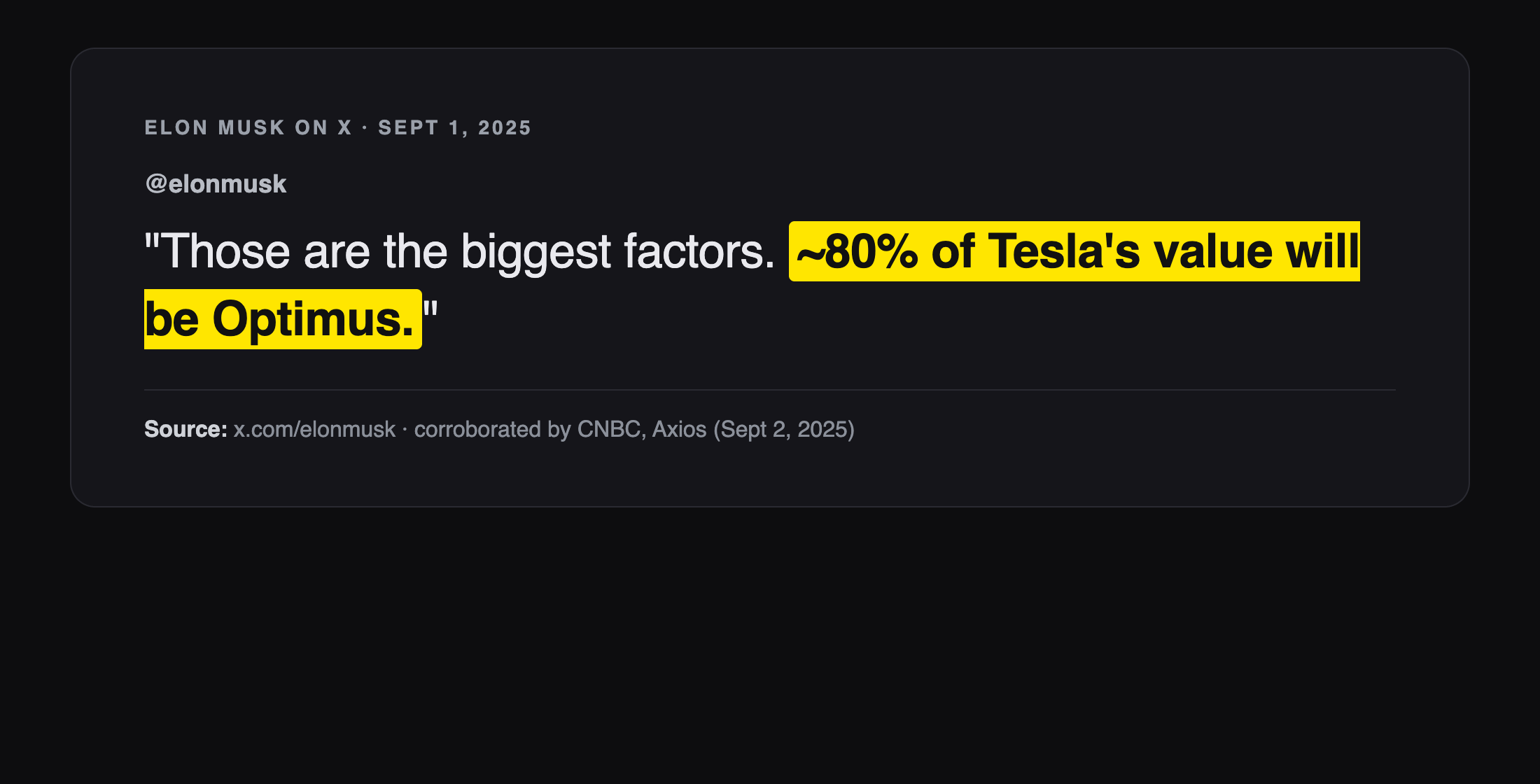
On the robot itself, you have to hold two facts at once and refuse to let go of either. What I mean is this: “~80% of Tesla’s value,” his words on X, with “the potential to be north of $10 trillion in revenue,” and that Tesla is converting the Fremont Model S/X line into a million-unit/yr Optimus factory while targeting 10 million/yr at Giga Texas.
However, the bears point out that Optimus is still in the R&D phase.
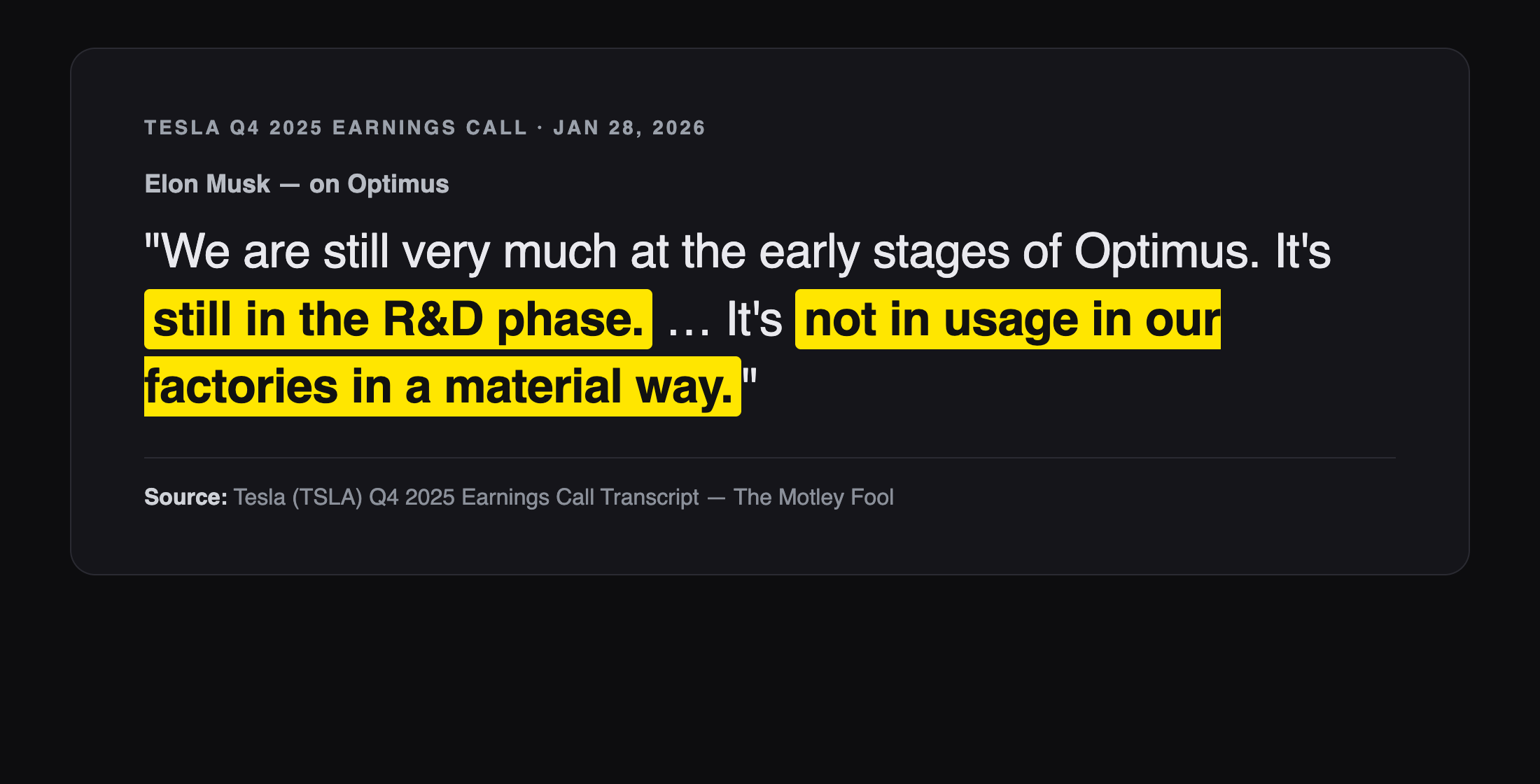
A few hundred units were built in 2025 against a stated target of 10,000, the most-watched demo was partly teleoperated by humans, and China’s Unitree is out-shipping Tesla on humanoids today. So Optimus is simultaneously the largest call option in the entire portfolio (in the machine), and the least proven leg of the thesis as of now.
VI. The Current
Strip away every promise dated 2028, and we are still left with a real thesis. Tesla deployed 46.7GWh of battery storage in 2025, up 49% YoY, at energy gross margins that have run from from the high 20s toward 40%. This is the Megapack business that quietly stabilizes power grids, oh, and powers xAI’s Colossus supercomputer in Memphis — a cluster of 555k GPUs buffered by more than 168 Megapacks, with hundreds of millions of dollars more on order. That is the loop I talked about earlier (remember the E2E): Tesla’s batteries powering the AI that trains Tesla’s cars.
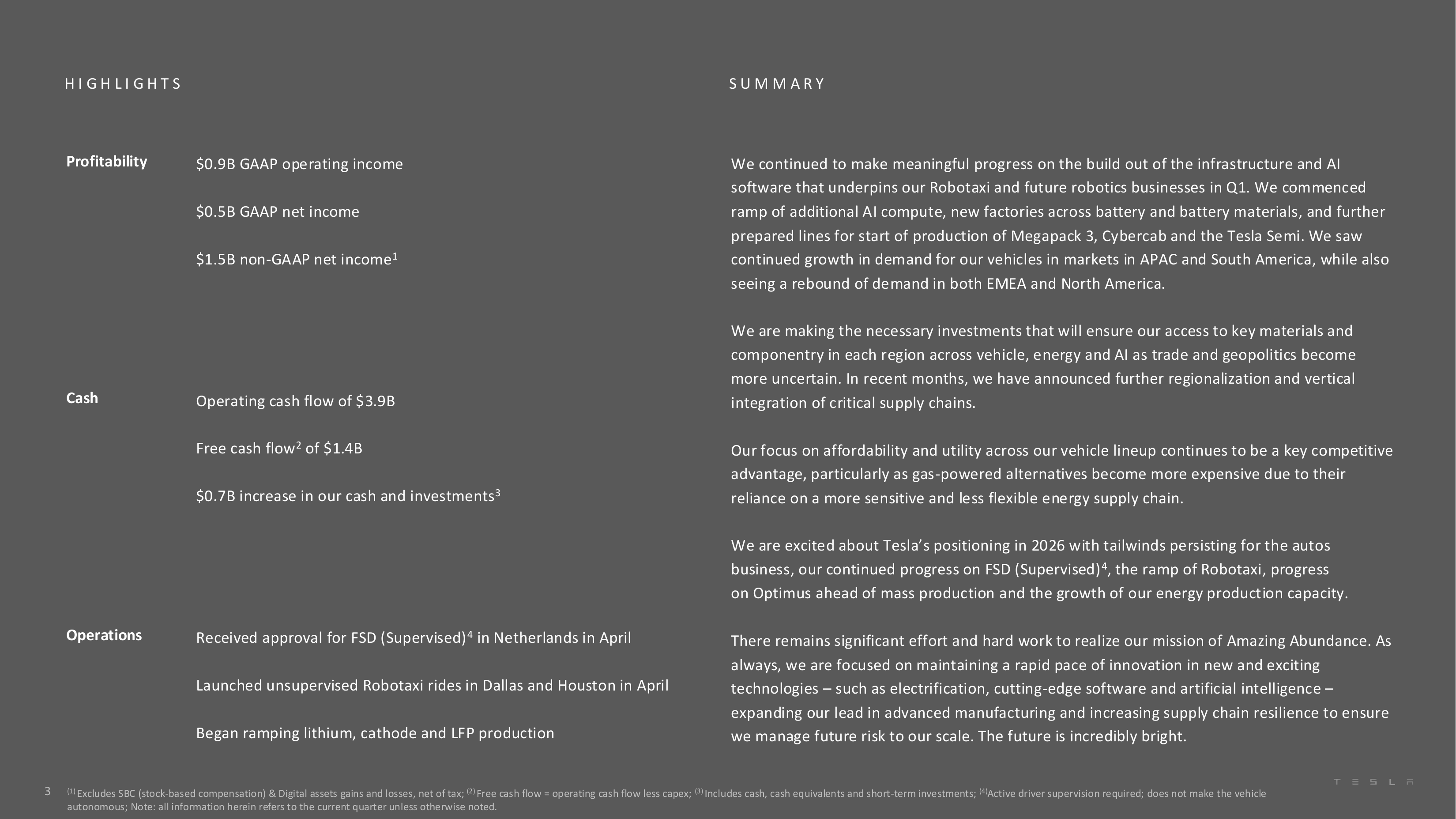
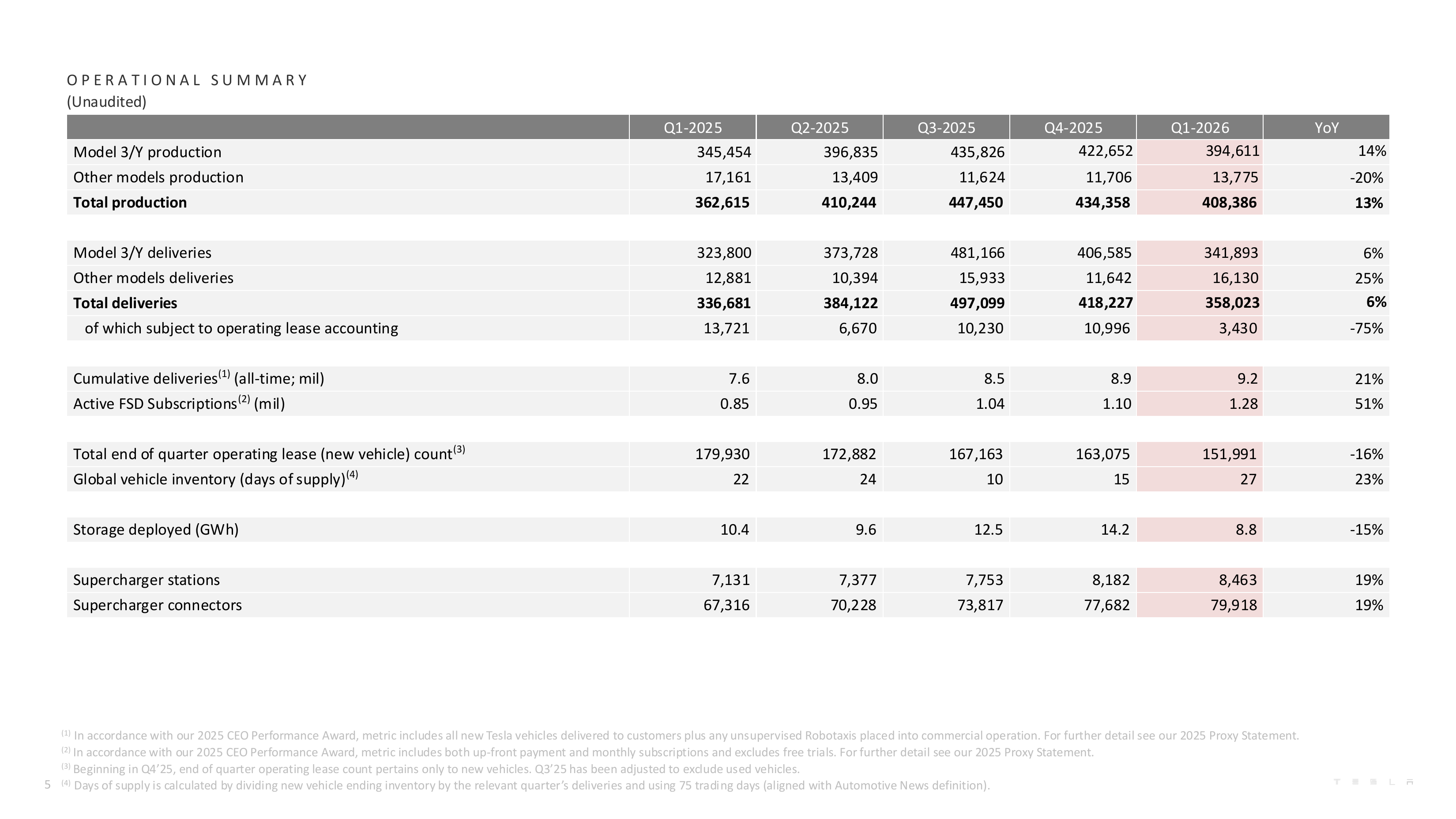
Storage deployments fell to 8.8GWh in Q1’26, down 15% YoY and 38% QoQ — a real miss, blamed on Chinese competition and tariffs. One soft quarter does not end the trend, in my opinion, but still watching closely.
The rest of the column is a mix of dominant and unproven. SpaceX flew 165 launches in 2025, roughly half of all orbital launches on Earth and over 80% of the mass that reached orbit. Starship is on its 3rd-gen design with 7 successes in 12 flights. Robotaxi, on the other hand, is real but small.
VII. The Machine’s Worth
I build these the way I built my IREN and AAOI numbers — from the company’s own figures up.
The Street has partly caught on. ARK models TSLA at $2,600 by 2029, with robotaxi as ~90% of that figure. Morgan Stanley flatly says Tesla is “no longer about EVs” and reframes it as embodied AI. BofA puts robotaxi at 45% of the value, Optimus at 19%, and FSD at 17%, with energy being a shy 6%. And sitting beside all of that is the new fact that the market is still digesting SpaceX.
Even Tesla’s own pay package tells you how the company wants to be modeled/valued. The $1T package shareholders approved back in November does not pay out for selling cars. It pays at an $8.5T market cap, on 20 million vehicles delivered, a million robotaxis, a million Optimus bots, and $400B of EBITDA.
So notice what I am not doing: I am not handing you a target, because the system is so early, with real option value sitting in orbit/Digital Optimus. So, I cannot give a real price target but rather a rough estimate. I’d say a $2,900 price target is relatively low (BY 2030, not 2029) if execution is clean and the numbers back it up, obviously. I think we are looking at the largest physical AI company, just my opinion, as of now. My bet is on the loop I mention, the bet is not a re-rating.
VIII. The Possible Fracture
My famous saying — not saying I am famous but you get the idea — is that a thesis you cannot argue against is not conviction, it is hope. So, here is the honest other side to my thesis.
The biggest risk by a wide margin is the timelines, Elon is notorious for missing exact dates.
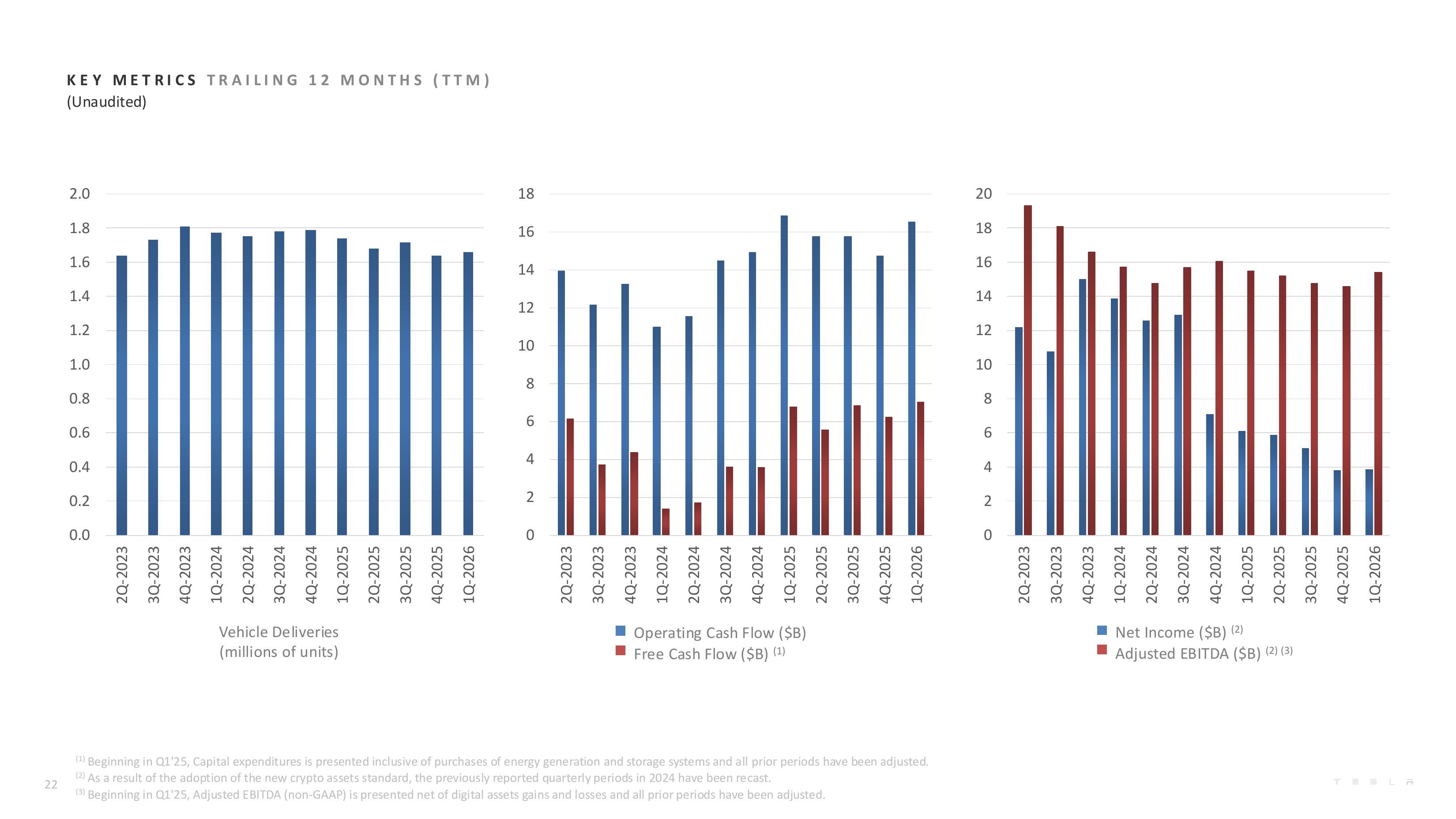
Underneath the promises, the proven business is shrinking. Tesla deliveries fell two years and still going, BYD took the global EV crown, gross profit per car is roughly half its 2022 peak. You are paying a robotics/AI multiple for a car business that is currently contracting. If autonomy slips again, and the base rate says it might, there is no earnings stream underneath to catch a potential fall.
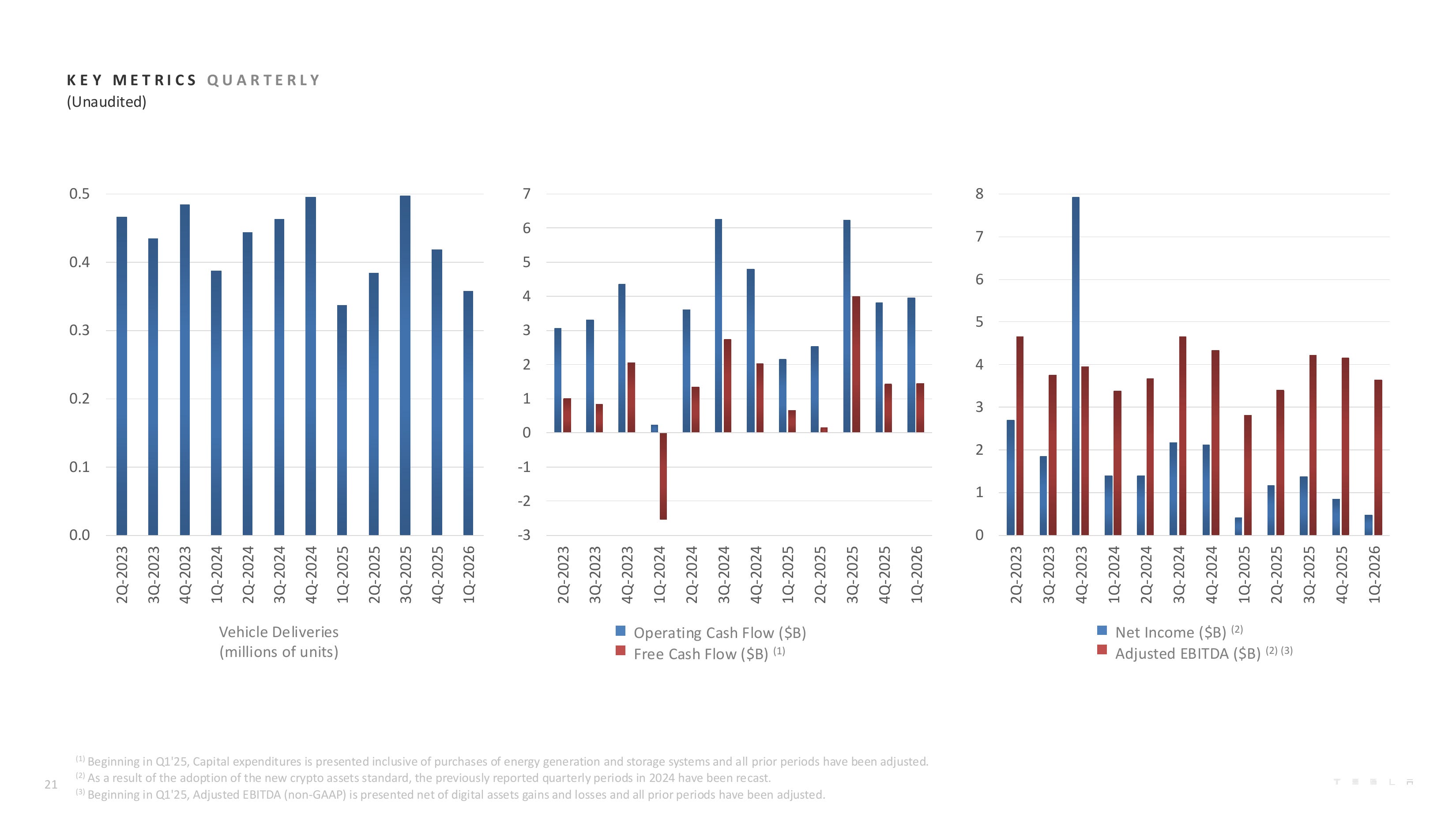
What my bull case leans heavily on, is unproven. I am not saying this is a safe stock, it is high beta. I hold both through chop because I believe the market is busy pricing the five separate companies instead of one machine. But, I could be wrong, and I am okay with that.
IX. The Line To Remember
Everyone is still arguing about whether Tesla is a car company or an AI company, whether SpaceX is a launch company or an internet company. It is the wrong frame and therefore the wrong things to be arguing about. Like I keep saying, it is one machine — energy, silicon, AI, robots, launch, and connectivity. It is the first of its kind.
The filings I dug through say where it is going. Chips by the wafer million. Your phone connected from anywhere on Earth. Robots as a labor force. Data centers in orbit by 2028. All in the docs.
Nobody’s reading the filings, but YOU just did!
I know it is different than my normal bottleneck post, fab posts, deep analysis of chips, but it is exciting to see what SpaceX and Tesla claim they will do. I just had to write about it to share everything I have been reading. If anything I wrote is wrong, please notify me!
Nothing here should ever be considered financial advice.